Newsflash: Building Relationships With Faculty Is Easier Than You Thought

I remember being a 1L and thinking that law professors were intimidating. Well, I could not have been more in the wrong. Professors at Loyola are available and always ready to help. Therefore, building a relationship with a professor is not hard. Professors have office hours, and most of them are even willing to talk by phone or skype. My best advice on starting a relationship with a faculty member is to start participating in class (as terrifying as that may sound). First, professors like volunteers, and second you get to show them you care about the subject, and consequently are respectful of them and their time.

Professors at Loyola have been so kind to me, one of my favorite professors helped me with my resume and even with networking. So, if you don’t’ have a relationship with at least a member of a faculty, you better start working on it!

My Clinical Experience at Loyola

As a transfer student, one of the biggest things that attracted me to Loyola was the number of experiential learning opportunities. From clinics to externships and more, Loyola offers something for everyone. Clinics and externships give students the chance to get hands on experience in various kinds of law.

While I was originally looking into a few different clinics, I decided on the Conciliation and Mediation Clinic (CMAC) at Loyola’s Center for Conflict Resolution (LCCR). In CMAC, students are trained to do actual community conciliations and mediations. Students work alongside knowledgeable staff and professors help people resolve their disputes outside of court. Although the LCCR mostly works with underserved groups, students still get experience with all kinds of cases from divorce to landlord-tenant disputes to debt collection. Depending on the client’s income, the Center’s mediation services are often free of charge.

People are often surprised to hear that most legal disputes don’t make it to trial. Many cases settle outside of court and one of the most prevalent alternative dispute resolution methods is mediation. With this in mind, I knew that my experience in CMAC would undoubtedly come in handy in my practice as an attorney. Even as a law clerk sitting in on mediations, I now have more of an understanding of the process and am able to get more from observing mediations.

As a 3L, I can confidently say that doing a clinic was one of the best choices I made during law school. It gave me the best firsthand experience that cannot be taught in the classroom. With so many clinics and externships to choose from, students are sure to find an opportunity that will directly enhance their legal education.

What You Need to Know About Loyola Faculty

Being in my third year of law school, I’ve had my fair share of experiences and encounters with the faculty. Here’s a list of the top seven things I’ve learned that you need to know about Loyola’s Faculty:

1) They have an open door policy, which means that they are accessible in more than one way or another to meet with you to go over your past exams, answer questions about lecture, or even just talk about their career path and how they got to where they are. This might seem very trivial, but in fact, it’s SO IMPORTANT. Professors know they can be intimidating, so they want you to feel comfortable to come to them to ask for help when you need it.

2) They want to get to know you! I remember during my 1L year, my criminal law professor held lunch breaks with groups of his students. We would eat lunch together outside Robinson Courtroom and share stories about ourselves and listen to how he got to where he is today.

3) Some of them are Loyola alumni too so they know a lot about the hidden gems on campus and can even relate to that one exam from that one particular professor. They’ve been through it!

4) Some of them are full-time professors while others are still practicing attorneys on the side. The latter have their day job and night job, which makes for some interesting conversations and eye-opening perspectives of what it is to be an attorney today.

5) They have cool hobbies outside of lawyering or being your professor just like you and me! In addition to being a practicing attorney beyond Loyola, some professors have fun hobbies like performing in a band, watching movies, or attending Coachella. While professors can be intimidating or appear intense, it’s always so cool to learn about what else they are passionate about and/or interested in.

6) Some of them, if not all of them, are experts in their field!!! They are people who have written your textbooks, drafted that treatise that you resort to when you’re doing legal research, worked with prominent judges, written amicus curiae in support of issues that are highly debated, served as correspondents on news outlets, etc. They are very well experienced in what they do and are passionate about it too!

7) From professors to the counselors to the people who staff the library and every other facility on campus, they care about students and fostering a creative, professional, and encouraging environment. Most importantly, they are genuinely interested in making sure that you thrive at Loyola and are able to pursue your interests and achieve your dreams. Whether it’s by reviewing your resume, giving you academic or professional feedback, or being a networking connection to someone in the industry, they go above and beyond to make sure you have the tools you need to get to where you want to go and be who you want to be.


If Only I Knew – A Few Helpful Hints for Your 1L Year

You can’t really know what law school is like until you’re actually in it. I have classmates who grew up knowing they were bound for law school, whose parents went to Loyola, who didn’t know how to outline or write a case brief. It’s okay. The learning curve is steep but most people get the hang of it within the first couple of months. There are however a few things that you can prepare for – things I wish I knew before I started and things that I am still working on. They essentially break down into two categories – study habits and life habits.

The three study habits that I wish I knew before I started were when to outline, when to start using supplement books, and where the good study locations are. First and foremost, an outline is basically your own summary of all the material in the course that you will need to know for the final. My outline was never more than 38 pages long and should probably have been shorter than that. You can find student-made outlines from past year on the St. Thomas More website but you’ll want to write your own.

Most professors will give you advise on when to outline but, generally, you should start your outline after completing the first major section of the course, usually three or four weeks into the semester – for example for Prof. Selmi’s (fantastic) torts class you should start outlining after you complete intentional torts.

Once you start outlining you should also spend an hour every Saturday and Sunday practicing that section from Example and Explanations books (E&Es) and other supplement books. Not all supplements are created equal. Some supplements cover material that is NOT covered in your class so ask your professor if they have any preferences or recommendations. You can burrow a lot of these supplements from the library, scan the entire book with the book scanner in the computer lab, and then upload the scans directly to your personal Google Docs account. Be a good person and share your scans with friends.

Finally, the good study spots are the small study rooms in the library (I like the basement). You usually need to reserve these in advance so beware if someone ever tries to kick you out of a study room. On sunny days, there are a couple great patios on the fourth floor on Burns building where all the faculty offices are located. The views of DTLA are not bad as you can see.

Two life habits that will help you are to manage your time around sleep and make sure to give yourself time for things that make you happy. I’m still struggling with the second of these habits. Try your best to get enough sleep every night so that you are pleasant to be around. At least in 1L year this shouldn’t be too terrible but make sure that you’re not pushing all your reading or studying for Sunday night.

You also need to get outside the library and do something productive that makes you happy. I like to swim, other’s like to go to the gym or walk around Santa Monica. My study group also did game nights and Korean barbeque nights. Keep your spirits up and you’ll do great!

A Piece of Advice for Entering Law Students

My first year of law school was a bit of a blur. I remember thinking about what the first day would be like. Would I get cold called like Elle Woods on her first day of Harvard Law? Would everyone be super competitive? Would I still know how to study after two years of being in the working world? While I did end up being the first person to get cold called in my Property class that semester, I quickly realized that I had just begun the biggest challenge of my educational career.

Looking back, 1L year was probably the most significant year of law school. Not only are you transitioning into a new chapter of your life, but you are also developing skills that will be the foundation of your legal career. At times it was overwhelming, and I wondered how I would ever be able to absorb all the information that was being thrown my way. However, over the next two semesters I realized that I had underestimated myself.

Law school has a weird way of making you step up to the plate. Ready or not, it’s happening. As such, I quickly realized I had to come up with a game plan. By the time first semester midterms rolled around, I found myself spending countless hours in the library reading, outlining, and preparing for exams. By the end of the week, I was tired and burnt out. You can imagine my surprise then when I got my first midterm back and didn’t do as well as I had hoped. I had studied more than ever and still did not get the results I wanted.

I must have been doing something wrong. When I told my 3L friend about my midterm, she asked me how I was studying. When I told her about my study habits, she quickly informed me that I was approaching it the wrong way. She told me to “study smart.” At first, I was confused: of course, I was studying—a lot.

How does one “study smart,” you may ask? For me, studying smart meant organizing my time better and learning how to prioritize. I would no longer get hung up on every minute detail of every topic when reviewing material or waste time creating flashcards that I would never look at again. Instead I found that big picture mind maps made the most sense to me and started scheduling my day out to make sure I got my school work done while also having time to myself.

Three years later, here is my advice to 1Ls: study smart. While I can’t give you an exact road map of what this means, I can tell you that my 1L year was much more enjoyable after I made these changes. And as always, realize that you have made it this far for a reason and soon enough you’ll be a 3L ready to graduate from one of the best law schools in the country.

And Just Like That, Another Year is Over

Welcome back to the Jury of Peers, readers! I hope this blog post finds you happy and well!

Can you believe it?! This is the last entry for the academic year! The spring semester is coming to an end, and summer is just around the corner, which means final exams, last minute studying, and summer jobs! It’s hard to believe that it’s already that time of year again, but 2L really has gone by so so SO FAST!

I am currently in the process of attending my final lectures for the semester and getting prepared for the exams season, which to be honest is and will always be a nerve-racking and stressful time. It’s truly crunch time trying to work on and finish course outlines, finish office hours for my clinic, the Project for the Innocent, and make sure I’m on top of all my readings and assignments for my courses that are still in session.

In addition, I am also in the process of figuring out what I want to do this summer. I am currently working on the transactional tract for the entertainment law concentration and one of its requirements is experiential. So I am currently trying to decide if I want to do an externship/field placement for credit during the summer or if I want to do another form of employment or internship. I am also trying to decide if I want to take classes over the summer so I can clear up some space in my schedule during my last two semesters and take other classes that I am either interested in or think would be fun. That being said it’s a lot to think about, and to be honest, I’ve been putting the thought of it on the backburner because I’ve really been trying to focus on my classes and getting the grades I need to put me in the best position heading into 3L. Am I stressed? You bet I am. Am I worried? A little. But I’m not letting myself get bogged down by those thoughts when there’s still a lot of work to get done this semester! There’s plenty of time to worry about jobs between now and the summer, and I’m hopeful that everything will work out!

On another note, I’m hoping to find some time to relax and spend time with family and friends this summer. It’s my final summer of law school, and I think that calls for some adventures!

So until the next time readers… enjoy your summer and see you in the new year!

The Benefits of Networking and Career Development Events

One of the things I love most about Loyola is their commitment to helping students network, learn more about various areas of legal practice, and connect them to established lawyers in those fields. I have found so many of the events at Loyola extremely helpful to helping me narrow down which area of law I’m interested in practicing, and helping me to make meaningful connections with lawyers who have experience with that particular area of law.

For me, one of the most helpful things that I have done was signing up for an Alumni Mentor. Prior to law school, I didn’t know a single lawyer. One of the first questions I asked my mentor was what I can do now, as a law student, to prepare myself to be a great lawyer, aside from the obvious things like studying and attending class. My mentor stressed the importance of gaining legal experience while in school, and after several conversations offered me a job at his law firm for this Spring.

As a 1L, much of the what we’re learning can often feel isolated from the “real world.” While it’s easy to relate the subject material of classes like torts or criminal law to common life experiences, it’s much more difficult to relate classes like civil procedure to things that we actually experience in everyday life. This has been one of the most useful advantages of working that I have experienced. Not only have I learned very practical skills like sorting and filing pleadings and other documents, I am also gaining real world experience doing legal research and connecting civil procedure rules to actual on-going cases. The rules of civil procedure have become less of a foreign idea and more of a familiar concept.

I’ve also attended several of the guest speaker lectures during the lunch hour and I’ve found that it’s a great way to be exposed to new and interesting areas of the law and to get perspectives that I might not otherwise be exposed to. Overall, I would strongly recommend taking advantage of as many of the programs as possible. While law school can be difficult, and the job market can be daunting, Loyola is a school that definitely does not take a “sink or swim” approach to things. They help out every step of the way.

Networking Is The Best Working

Something that is great about law school is that you take a lot of different classes, especially as a 1L. You take the basics: Criminal Law, Torts Law, Property Law, Contract Law, and more. You get a little taste of almost every basic area of the law, and that allows you to get an idea of what really interests you going forward. For me, Criminal Law and Torts Law really stood out. Property and Contracts, not so much. So, I knew the two areas I wanted to explore further.

It is the same way for networking around campus: there is a club representing almost every area of law. They bring practicing attorneys onto campus and have them give lectures, so you start to get an even better idea of what people in that field do. You also get the chance to meet and network with those people, which is even more invaluable. So many people I know have gotten interviews or even mentors in this way or just because of a lecture they attended on campus.

Semester of Opportunity

Law school has been a roller coaster so far. It has been exciting, tiring, challenging, and, most of all, humbling. Sometimes, there are moments when I ask myself it it’s worth it. These mostly occur when I’m up at 7am driving to school, during a cold-call when I’m not quite sure of the answer, or when I’m working on what feels like a never-ending paper. And, occasionally, there are moments that make everything worthwhile.

They say that if you enjoy what you do, then you’ll never work a day in your life. While I’m not naive enough to think that having a passion for the area of law that I will ultimately practice will be enough to make everything exciting and fun, I do believe that passion can make the hard work, long hours, and mundanity that I will doubtlessly experience worthwhile. If you’ve been reading my blog, you’re probably aware that I have many passions. But how do I tie my passions in with the law?

That is exactly the question I approached one of my professors with. As a 1L, thinking about electives and summer jobs can be overwhelming. The law is so diverse, and there are so many areas that I haven’t been exposed to yet. In previous conversations with my professor, I had told him of my strong interest in women’s issues and how they intersect with the law. My professor gave me an incredible opportunity to join in on a conference call with another incredible student, and two fantastic ladies from the LACBA. The lawyers were interested in putting on an event at Loyola for the women law students and, after two conference calls, the idea of a mentoring event became a tangible plan complete with a name, a logo, and a date.

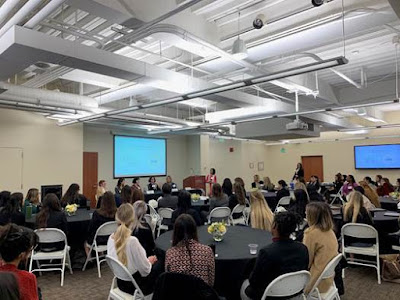
The end result of the event was incredible. It was one of those moments that I mentioned where all of the hard work feels worthwhile. Twelve fantastic women lawyers came and spoke to about sixty students, mostly 1L women. I’m sure that many of those discussions blossomed into mentor relationships that will help these women students navigate the often-challenging employment climate, myself included. That was satisfying.

This semester has been the semester of opportunity. From helping to organize the Women’s Law Collaborate event alongside such inspiring ladies to being able to choose my first elective, Alternative Dispute Resolution, to starting my first legal job this past January, the opportunities have seemed endless. I am grateful to have worked with such inspirational ladies, and I excited for what the future of what it means to be a lady in the legal profession. I hope to work with them and women (and men too!) of similar drive and ability for years to come!

I Love That Loyola Is A Law School for Los Angeles

Everyone has their expectations of what law school will be like when they get there. If you don’t have family members or close friends who’ve gone through it, those expectations are probably shaped by movies and TV. Some images are very familiar: mountains upon mountains of homework; humiliating cold-calls; classmates ripping pages out of library books so no one else can study from them. It’s all enough to make you wonder why anyone goes to law school in the first place.

Loyola definitely is not like that. (And, for all I know, neither is any other law school – I mean who, in the 21st Century, even looks at library books anymore?) Loyola is a down-to-earth place; a place for students who are ready to dig into their work as lawyers. An attorney I know who practices in L.A. – a person who did not go to Loyola – once described Loyola as “the city’s law school.”

I love that idea. I feel great when I see that idea borne out in real life. I see it manifested in many of the students, who are hard-working, unpretentious, and always willing to collaborate. A good many, it seems to me, are eager to work through law school so they can go on to join the bloodstream of this city – perhaps in public service, or on behalf of clients with special needs. In my own experience interning in both government and public interest law offices while at Loyola, I’ve met so many inspiring grads – from judges to civil rights lawyers to executive directors of nonprofits. They all seem particularly well-prepared for the avenue of service they have pursued.

I’m inspired by the idea that Loyola is where so many people who want to serve this city come to get their education. After all, it has a nearly 100-year history of educating lawyers, much of that history at its current campus adjacent to downtown, where there are so many in need of representation.

If you want to go to law school, but worry the environment will look too much like what you’ve seen in the movies, I can reassure you – that’s not Loyola. While it’s by no means easy (it is, after all, law school) it’s a supportive environment, and one that particularly speaks to the ideal of service. To call Loyola “the city’s law school” is, I think, to pay it a tremendous compliment.